· Technology & Society · 3 min read
Why We Need Industry 5.0
Puts human wellbeing at the center of production, alongside AI and related technologies.

For the past decade, the manufacturing world has been obsessed with Industry 4.0. We focused on the “Smart Factory”—an interconnected web of IoT sensors, Big Data, and relentless automation. The goal was simple: peak efficiency. But in our race to build the perfect machine, we accidentally left the most important component behind: the human.
As we look toward 2026 and beyond, it’s clear that efficiency alone isn’t enough to sustain a global economy facing labor shortages, climate crises, and a demand for personalization. Enter Industry 5.0.
What is Industry 5.0?
If Industry 4.0 was about “how can machines do this faster,” Industry 5.0 is about “how can machines help people do this better.” It isn’t a replacement for its predecessor; it’s a necessary evolution.
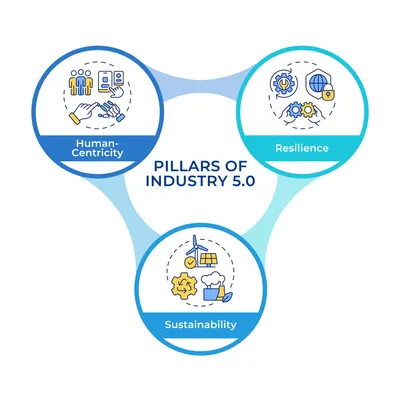
It moves the needle from pure digitalization to a human-centric, resilient, and sustainable framework. It’s the “correction” the industrial world needs to ensure that technology serves humanity, rather than forcing humanity to conform to the limitations of technology.
Why the Shift is No Longer Optional
1. The Human-Centric Correction
Industry 4.0 often treated workers like “cogs in a digital machine,” leading to burnout and a staggering $8.5 trillion global talent gap. People don’t want to compete with robots; they want to collaborate with them.
Cobots (Collaborative Robots):
Instead of being fenced off, these robots work alongside humans, taking over dirty, dangerous, and dull tasks
Empowerment:
We can no longer ignore planetary boundaries. Industry 5.0 shifts from “minimizing harm” to “creating positive change.”
2. Radical Sustainability
We can no longer ignore planetary boundaries. Industry 5.0 shifts from “minimizing harm” to “creating positive change.”
Circular Economy:
It promotes processes that prioritize recycling, repurposing, and zero-waste manufacturing.
Energy Efficiency:
Leveraging AI to optimize energy consumption in real-time, reducing the carbon footprint of heavy industry.
3. Building Resilience into the DNA
The global supply chain shocks of the early 2020s proved that efficiency is fragile. If a system is too lean, it breaks.
Industry 5.0 prioritizes resilience—the ability to bounce back from natural disasters, pandemics, or geopolitical shifts.
Localized Production:
Using 3D printing and modular AI to produce goods closer to the consumer.
Agile Systems:
Combining human intuition with machine speed to pivot production lines in hours, not weeks.
The ROI of “Human” Innovation
Skeptics might see Industry 5.0 as a “soft” concept, but the business case is concrete. Companies adopting this mindset see:
Higher Retention:
Workers who feel valued and safe stay longer.
Mass Personalization:
Machines provide the scale, but humans provide the “craft” that customers are now willing to pay a premium for.
Lower Risk:
Human-machine collaboration reduces workplace injuries (which currently cost roughly 4% of global GDP).
Final Thought: A Cultural Revolution
Industry 5.0 is less of a technical upgrade and more of a cultural shift. It’s a commitment to the idea that industrial progress should be measured by the well-being of the society it serves, not just the speed of its assembly lines. The future of industry isn’t just digital—it’s deeply, and finally, human. Is your organization ready to put the “soul” back into the machine?